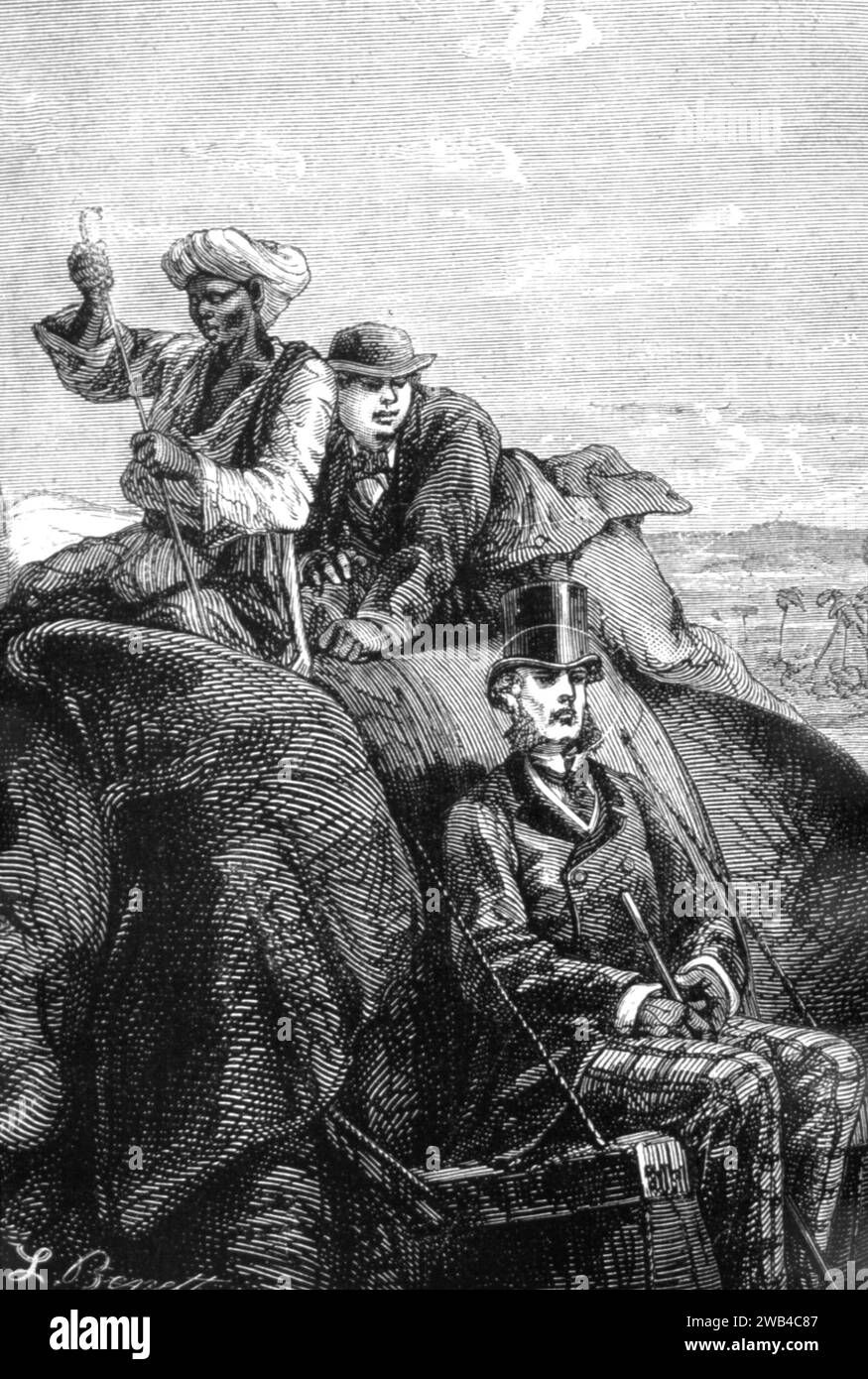
Phileas Fogg Traveling in India by Elephant
“The unforeseen does not exist.”
Was Phileas Fogg correct about this in regard to travel?
Let’s back up a bit to start. Who was this Phileas Fogg guy anyway?
Well, in case you didn’t already know, Phileas Fogg is the hero of Around the World in Eighty Days, a marvelous novel written around 1870 by the popular French author Jules Verne, translated into English from the French original, Le Tour du monde en quatre-vingt jours.
The plot is ingenious and fascinated Brian’s ten-year-old mind after he received a copy as a gift. Phileas Fogg is a wealthy Englishman, depicted by his French author as possessing the stiffest of British stiff upper lips. In the course of a card game at his exclusive London club, he makes a huge bet against four fellow members.
It happens that three massive projects completed around this time made a tourist-style trip around the world at least a possibility. The first U.S. transcontinental railroad line was completed in 1869, and the Suez Canal was completed in the same year. In 1870 Indian railways were linked across the sub-continent.
After a brief discussion of a newspaper article claiming it was now theoretically possible to circumnavigate the earth in eighty days, Fogg declares it could be done and soon bets half of his fortune against his fellow card players that he can accomplish this feat.
When one of the other club members warns Fogg that he could lose his money “by a single accidental delay,” he quietly retorts “The unforeseen does not exist.”
Young Brian took that statement literally. Old (make that mature) Brian recognizes the irony of the comment, particularly since the balance of the book is devoted to describing the many unexpected obstacles Fogg faces and manages to overcome ingeniously, often by spending down the remaining half of his fortune, on his ultimately successful journey.
It’s still a marvelous read a century and a half after it was written, and a reminder for those of us who value comfort and predictability in our travels that those are never guaranteed. You can prepare down to the smallest detail (and we two tend to do that), but something unforeseen can still disrupt your journey.
The trick, if it’s a trick, lies in how you deal with the unforeseen. We ourselves try to maintain a positive mental attitude, no matter what gets thrown our way. We carry paper documentation of everything connected with our itinerary. When planning our schedule, we try to allow adequate time between, for example, landing at Frankfurt Airport and catching a train in the airport terminal to another destination. If we're relying on a hotel's airport shuttle, we'll call in advance for explicit details if they're not published. Does the shuttle run continuously, hourly, or on call? Along with the instructions, we'll have the hotel's phone number readily available in our TripIt.
Equally important to us as senior travelers is allowing ourselves time to rest along the way. Gone are the days that we would depart early from a European airport, fly to New York or Chicago, transfer to a domestic flight to San Francisco or Los Angeles, transfer to another flight to Seattle, and then pick up our car and drive home two hours up I-5!. Just thinking about that regimen nowadays tires us out.
These days we include in such a flight itinerary at least one night’s stopover along the way, quite happily paying for an extra hotel night in return for a chance at a decent night of rest.
We are much more inclined to hire a taxi or an Uber than to pull our rollaboards long distances.
We share the views of many who consider air travel in particular these days as something to be endured rather than enjoyed. We aim more and more to make the travel part of our trip as pleasant as possible – or at least tolerable, realizing that "getting there" isn't often “half the fun.”
When things go wrong despite our planning, we try to look on it all as part of the adventure of travel.
We like to think even Phileas Fogg might approve of that.
I remember the story….i was about your age when I first read it and it made me think deeply about time zones….
ReplyDeleteLol
The International Date Line wasn't established until 1884, but carping critics claim that Fogg would have kept track of the dates when he consulted train and ship schedules. We say it's an excellent plot gimmick and let's not get bogged down in details.
Delete